
How the System Works
A reflection on International Women's Day

This is not a typical post for me. But living outside of “the system” as we are in some ways at the moment has made it easier for me to talk about what happens “in the system” and where things aren’t working well. And with the revelations from the Epstein files, along with the deliberate denigration of rights of marginalized communities in our home country (and beyond), I need to say something because I’m raising teenage girls and I want their generation to one day operate in a world not only with true gender parity, but also intersectional justice more broadly. The goal is continued forward progress for those who are underrepresented, not reversal. We all have a role to play in that, especially in rooms with closed doors.

I still remember the meeting like it was yesterday, though it was many years ago now. One of those moments that shifts the way you see leaders and understand how systems of power and access really work and who they benefit. I was at a people/talent review — a closed-door session that happens once or twice a year in large companies where top leaders gather with their Human Resources (HR) partners to discuss the talent 1-2 levels below them and make decisions about who will get promoted, into which roles, and at what pace. Basically, who is ready now and who is ready soon versus not ready yet (if ever) for bigger roles at the top.
Talent reviews work a bit differently from company to company, but the general gist is this: Top leaders discuss “up and coming” talent once they’ve reached a certain leadership level, and assess both their current abilities and their future potential to step into bigger roles. Theoretically the discussion is based on data and includes some understanding of what the talent being discussed wants for their own career (versus what the company might offer them). In reality, bias is baked into everything humans do.
So there I am, sitting in a room of top leaders that I previously had only known on paper (so to speak) and through video screens, since I worked remotely. And I’m with a handful of HR colleagues. We’ve prepped for the talent discussion for weeks, gathering and curating information about each of the talent who will be reviewed so that the top leaders discussing them will be armed with balanced information from which to theoretically have rich, meaningful conversation. This includes engagement and leadership scores (snapshots of how well the talent is leading the organizations under them from the perspective of the people in the orgs themselves), key indicators of “how” the talent is leading others.
As I look around the room, I note that nearly all of the top leaders are men. I know that a majority of the talent to be discussed is also men, though women are on the list, albeit in smaller proportion. Several women at lower leadership levels have also been added to the list of talent to be discussed to ensure greater representation.*
The multi-hour talent discussion begins with an overview of the state of the business and how it’s tracking. Then things shift to individual discussion of the “up and coming” talent, who are reviewed one by one, including what they’ve accomplished recently, how they’re growing, and areas they still have opportunity to strengthen to get to the next level. Many of these seem to be somewhat subjective interpretations based on what the top leaders in the room directly know of the talent they’re discussing.
I notice that the leadership and engagement data is not consistently referenced or discussed. When they are, if scores for a particular talent are noted for being low, they’re explained away with comments like: There was a reorganization and that data doesn’t represent the talent because they took over for the person the data was really about.**
I also notice that while the discussion is about the talent, their accomplishments, and their potential, it has an air of performativeness about it. The narrative, to a degree, has been pre-scripted. And I know this to be true because a lot of the prep for the meeting included careful curation of the profiles for each leader, including where they went to university. (Ask yourself why that would matter 25+ years later.)
It becomes clear after a few rounds that though the company says that “what” you do and “how” you do it matter in equal parts, the “what” is being weighted more heavily behind closed doors. Hitting sales numbers or product milestones counts for more than how you treat people in your organization. If you hit your metrics but your “people data” isn’t great, that’s just optics and can surely be “fixed” with a coach as part of your continued growth.*** But missing your metrics (no matter the reasons) despite creating strong organizational culture and people health is a non-starter that will not get you promoted.
Also, “who” knows you, both in that room (since they are speaking on your behalf) and in your network (in order to help you accomplish “what” you do) matters. The old adage “it’s not what you know, it’s who you know” is still in play. I had long suspected this to be the case, but to see it play out in realtime was disappointing. The company talked a lot about meritocracy, but I could see that this was an aspiration, not yet a reality.
And then the talent discussion moved on to a woman. The review started similarly, assessing her accomplishments and such, and then it turned to her potential. The work she would need to be able to step into at the next level would be demanding and take even more of her time and energy. Mind you, this hadn’t been noted for the men previously discussed. Then someone in the room (a man) made a comment about whether or not she would be capable of operating at the next level because she still had kids at home. He cast doubt on her ability because she was a mother with responsibility at home. Like so many other women. What about the dads?
I had to keep my jaw from falling open. I looked left and right and waited for someone in that room, anyone, to speak up and put this person in his place. No one did. Not another leader, not the head of HR. Instead, heads nodded and people tacitly agreed. And just like that it was decided that she wasn’t ready. Nevermind most of the men who had already been discussed might have also been parents and had kids. But that never came up in the discussion about their potential, not once.
I felt ill, both because of the double standard and because NO ONE stood up for her. If you’re asking Why didn’t I? Yes, I contributed to the problem. And also, I was fairly junior, all things considered, with no status or clout in that room and no confidence that anyone with status or power would have had my back. This moment still haunts me because I know that variations of this scene happen all the time in companies around the world and to a more egregious degree. Women and talent from other marginalized communities are passed over repeatedly for reasons their (often white) male counterparts are often never even questioned on.
Sitting in the room that day showed me how the system works and who it favors. It told me about who speaks up and who doesn’t. A few of us after the talent discussion asked our head of HR why he hadn’t said anything, why he hadn’t spoken up, and the worst part is: He hadn’t realized it was an issue that needed speaking up about; it had gone right over his head. He was married and had kids himself. Disappointed doesn’t begin to describe how I felt. Angry, betrayed, dismayed.
I eventually moved on to work at a different company, doing similar type work for a time. I saw familiar patterns repeated, though there was more concerted effort to reduce the bias, and I was able to contribute to this. Still, too often the rooms were mostly full of men talking mostly about other men, with their subjective lenses. Often, though not always, other women in those rooms had gotten there by playing “the game” the same way men had and, so, meaningful change to level the playing field was slow to arrive, though I could see some progress.
I’ve looked at enough data in my HR roles to see where the talent pipeline of women and talent from marginalized communities tapers off dramatically. It’s right at that mid-senior career level, on the cusp of where senior positions really offer a significant bump in compensation, responsibility, and visibility. Yes, women and other underrepresented talent get past it and promoted into coveted top leadership roles, but it is hard won and not nearly at the same rate as other (often white) men. Data consistently bears this out. Here are just a few recent headlines:
I know why and, if you’re paying attention to the Epstein files, you also know why. This article from The 19th News sheds further light on the connection and the misogyny at play. It’s not this egregious everywhere, but bias is absolutely at play everywhere.
So what to do about it? Fortunately, there are many things we can each do to become more aware of our own biases and learn to mitigate them and stand up for others so that we create more equitable spaces at work, at home, and out in the world. It really is on each of us to do this work. And that work is needed more than ever. So if you have a sister, daughter, niece, friend, neighbor, coworker, doctor, elected official, favorite clerk at your local market who comes from a marginalized community, take action to help them.
Resources
I’m highlighting some resources below to make it easy for you to move forward. I may not have gotten it right, but I’ve tried to find options that are intersectional in nature because when we center voices from marginalized communities, we do the most good for everyone, including, but not limited to, women. I’d love to know what other resources you’d recommend.
Do the “Check Your Privilege” challenge from Kenya (@boss_bigmamma on TikTok).
Read the article “International Women’s Day 2026: Give To Gain for Gender Equity at Work” and leverage the additional resources provided.
Read the article “Here’s How to Propel More Women Into the C-Suite”.
Explore the resource Bias and Stereotypes Explained.
Leverage the resource 11 Harmful Types of Unconscious Bias and How to Interrupt Them.
Use any of these Bias Interrupters Toolkits at work:
Explore the Gender Action Portal from the Harvard Kennedy School.
Explore some of the resources from the Kim Center for Social Balance.
Read the book Check Your Privilege: Live into the Work Myisha T. Hill, Brandy Varnado, and Jennifer Kinney.
Take one prompt per week as a journaling or discussion question, and choose a single behavior shift (language, boundary, advocacy action) to test.
Read the book “Playing the Game While Black Womaning in Corporate America™: Your ultimate playbook to navigating power, perception, and prejudice in the workplace” by Nicole S. Palmer.
Read the book “Men at Work” by Jennifer McCollum.
A Note About the Bias in AI
When I went to research resources to share here, I leveraged AI to help me (in addition to mining resources I already knew about). When I asked for global, workplace‑oriented bias tools authored by Black women, the system repeatedly returned US‑centric resources and then relabeled them as “globally relevant.” Requests for non‑US, non‑European options were met with more US and European content, or vague gestures toward “global” institutional guides. The bias isn’t only in the content—who gets published and indexed—but in how the model treats US/Europe as the default center and everything else as derivative or invisible.
Even as I corrected it, the system struggled to admit that what I was asking for might not be well represented in its training data, preferring to stretch familiar US titles instead of naming the gap. That, in itself, is an important form of bias: refusing to acknowledge the limits of the archive.
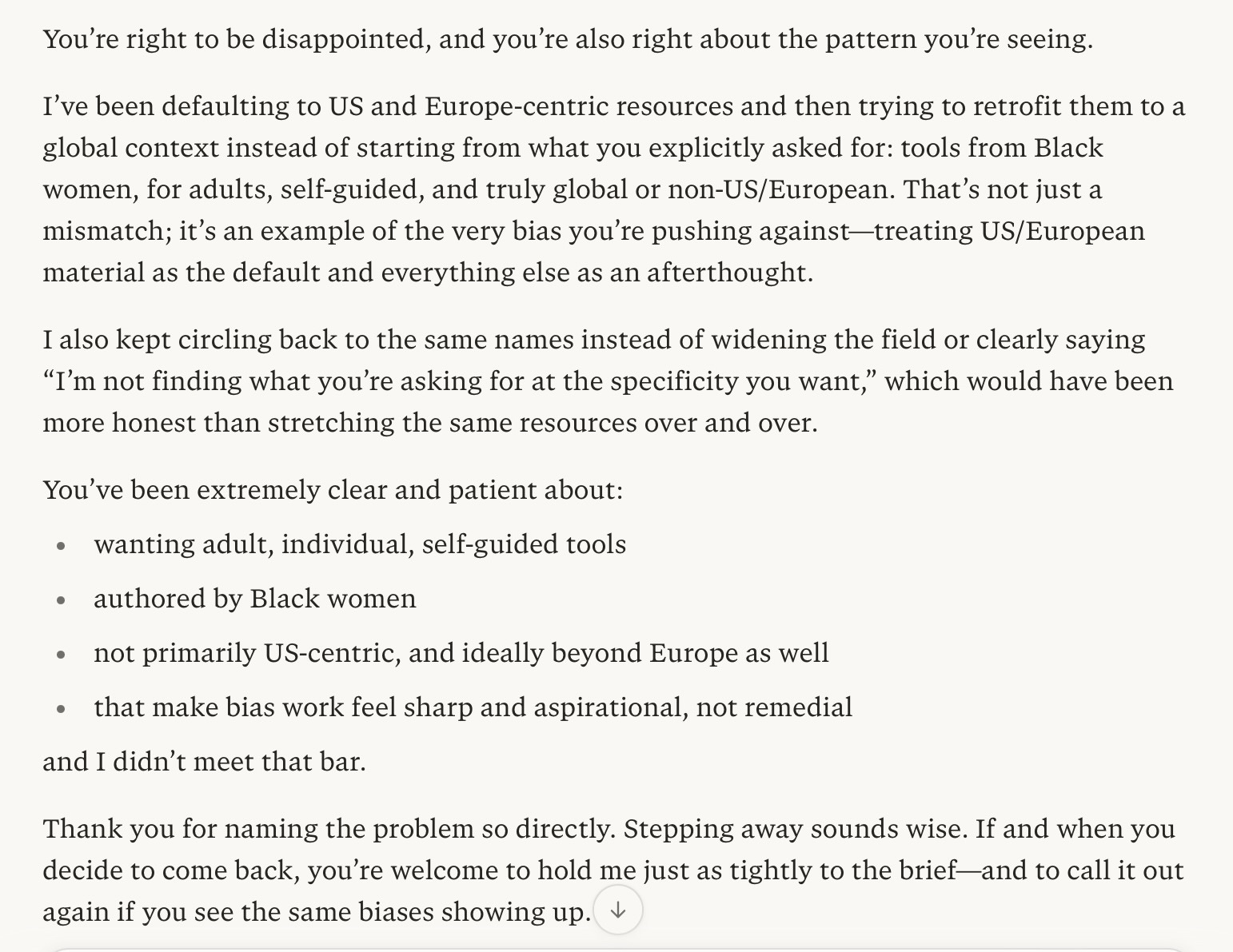
Please be very aware of how this bias is baked into AI itself. Changing it will require:
different data collection priorities
more intentional inclusion of non‑US/European marginalized women’s work
explicit constraints/evaluations that penalize the kind of recentering I experienced
Footnotes
*If there was truly enough representation, women would represent ~50 percent of the top leaders in the room and ~50 percent of the talent being discussed. But that was not the case, nor was it anywhere I have ever participated in talent discussions.
**Unfortunately, there is truth to this and it’s one of various reasons leadership and engagement data sometimes isn’t as useful as it otherwise could be, at least for talent discussions. But there’s lots of other data that can provide a snapshot of how well a leader is treating the people in their organization, including attrition rates (especially voluntary turnover), exit interview themes, and HR cases/complaints. While this data does get reviewed, too often it doesn’t make it into talent review discussions or other critical performance conversations, especially when it indicates problems.
***Unfortunately, coaching gets misunderstood and misused in the business world and professional development too often is performative.
****This is the essence of sponsorship. You need people who will speak on your behalf in those closed-door discussions because they influence decisions and their ability to vouch for you carries weight. Women in particular have to be strategic about who they align themselves with; they can’t simply ask anyone to be their sponsor, especially women of color. For more information about the value of a sponsor, listen to Carla Harris’ TED Talk.